


KAMA SUTRA and The 64 Traditional Arts
- Aiyana Saint Gimbel

- Jun 14
- 7 min read

Welcome to WildlyAiyana Traditional Arts. This space was born out of a profound curiosity for the timeless, the handcrafted, and the deeply intentional. It is a digital sanctuary dedicated to reviving ancient lineage wisdom, traditional crafts, and a way of being that treats daily life not as a checklist of tasks, but as a living canvas.
Here, we don't just study history; we invoke it. We ask what it means to live dynamically, creatively, and wildly alive. And to begin that journey, we must look back to an ancient philosophy that understood human refinement better than perhaps any other: the classical tradition of the 64 Arts.
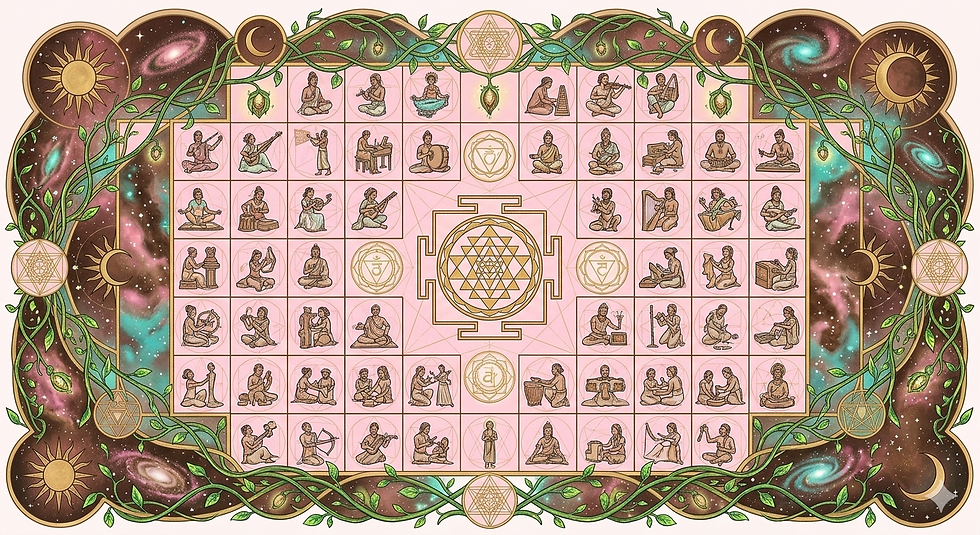
Step inside, breathe out, and leave the frantic rush of the modern world at the threshold. Beyond the Position: The Kama Sutra You Never Knew. HOW MANY OF THESE 64 ARTS Do You ALREADY Know!? There is no such thing as a Fool of All Trades, Master of NONE in the New Earth Consciousness....
When most people hear the term Kama Sutra, their minds immediately jump to the modern, hyper-sexualized interpretation of an ancient manual. But if you peer past the pop-culture surface, you discover something infinitely more beautiful, radical, and inspiring.
Written centuries ago by the philosopher Vatsyayana, the Kama Sutra is actually an expansive textbook on Kama—one of the four pillars of a balanced life, representing love, desire, sensory pleasure, and aesthetic joy. It was designed as a guidebook for the cultured citizen. It argued that to live a life of deep fulfillment, one must cultivate a mind and spirit that are deeply engaged with the world.
At the very heart of this vibrant lifestyle was the mastery of the
Chathushashti Kalas—the 64 Traditional Arts.
What Will a Devotion to These Arts Reveal?
The 64 Arts represent a philosophy where curiosity is a sacred virtue. They remind us that true intimacy—with a partner, with nature, and with ourselves—is sparked when we sharpen our intellects, refine our senses, and master the physical world around us.
When we explore the traditional arts through the lens of WildlyAiyana, we are looking at what these practices will awaken within a modern life:
AN Awakening of the Senses
Through the practices of Gita (vocal music), Vadya (instrumental mastery), and Alekhya (painting), we learn to truly listen and see. These arts transform the home into a sanctuary of sound and color, ensuring that our daily environments feed the soul rather than drain it.
A Harmony with the Material World
The traditional arts demand that we ground our creativity in tangible, practical wisdom. Through Sudakarman (the culinary arts) and Vrikshayurveda-yoga (botany and plant medicine), we learn the alchemy of spices and the healing rhythms of nature. They teach us how to sustain our bodies and cultivate the earth, transforming cooking and gardening into acts of profound devotion.
A Playful, Agile Intellect
True refinement requires a mind that can dance. Through arts like Kavya-samasya-purana (spontaneous poetic completion) and Mlecchita-vikalpa (the creation of secret cyphers), we discover the sheer joy of mental agility. These arts represent the thrill of wit, the beauty of shared secrets, and the understanding that a sharp mind is an endlessly captivating force.
The Journey Begins Here
The 64 Arts are not archaic relics to be left on a dusty shelf; they are pathways to a more intentional, enchanted existence. They promise that if you commit yourself to continuous learning and sensory refinement, you will never cease to be a source of fascination—both to yourself and to the world around you.
The Sanskrit Language is the ORIGINAL SOUND HEALING ~ I will break these 64 arts down to you in a way that relates an English Version: 1. The Arts of Performance and Entertainment
These skills were meant to make you the "life of the party" and a master of expression
.
Music and Singing: Not just vocal music (Gita), but also playing instruments like the lute and drum
.
Theatrical Arts: This includes acting and storytelling (Natya) to entertain a crowd
.
Water Music: A unique art of creating rhythms by striking cups or glasses filled with water (Udaka-vadya)
.
Animal Training: Organizing and understanding the fighting styles of animals like rams or cocks for entertainment
.
2. The Arts of Style, Grooming, and Beauty
Personal presentation was seen as a way to show respect for yourself and others
.
Painting and Drawing: Considered the 4th most important art, focusing on "secrets of form" and "grace" (Alekhyam)
.
Body Decoration: The art of applying patterns to the forehead (Visesakachhedya) or dyeing the hair, nails, and teeth
.
Floral Design: Creating intricate floor patterns with colored rice and flowers, similar to modern Rangoli
.
Jewelry and Fashion: Learning how to set gems, weave flower garlands, and even tie stylish turbans
.
3. Practical Skills and Household Mastery
These were the "useful" arts that made a person self-sufficient and capable of running a home
.
The Culinary Arts: Cooking, making sweets, and mixing flavored drinks like syrups or cocktails
.
Building and Crafting: Skills like carpentry (Taksan), needlework, and even making children's toys
.
Gardening: A sophisticated person was expected to understand botany and how to care for a garden (Vrikshayurveda-yoga)
.
Metallurgy and Chemistry: The scientific knowledge of how to purify metals and test the quality of silver and jewels
.
4. Arts of the Mind and Communication
Intelligence and wit were considered just as attractive as physical beauty
.
Poetry and Riddles: Games where you solve puzzles or complete a poem on the spot (Kavya-samasya-purana)
.
Memory Training: Practicing how to remember long texts after hearing them only once
.
Secret Codes: Learning how to speak in sign language with fingers or write in secret ciphers and foreign scripts (Mlecchita-vikalpa)
.
Lexicons: Studying dictionaries and the deeper meanings of words to improve conversation
.
5. Games, Play, and Physical Fitness
These arts focused on recreation and maintaining a healthy, agile body
.
Board Games and Strategy: Mastering games like chess (Chaturanga) or various types of dice and gambling
.
Gymnastics and Martial Arts: Physical fitness, wrestling, and the use of bows and arrows to stay strong and disciplined
.
Magic and Illusions: Using sleight-of-hand and sorcery (Indra-jala) to entertain and amaze others
.
Why These Arts Mattered
The sources emphasize that someone who mastered these arts—whether a king’s daughter or a common citizen—would be respected by leaders and highly sought after as a partner
. Even if a person fell into hard times, their knowledge of these skills would allow them to support themselves anywhere in the world
.
The SANSKRIT LANGUAGE - Is the ORIGINAL SOUND HEALING ~ dyk that Cymatics is the study of Sound Vibrational Arts and the words spoken in Sanskrit can appear as sacred Geometry in the spirit smoke of incense? Here are the 64 Arts names in Sanskrit:
Here is the complete, traditional list of the 64 arts (Chathushashti Kalas) as compiled in the Kama Sutra.
Gita – Vocal music / Singing
Vadya – Playing musical instruments
Nritya – Dancing
Natya – Theatrical acting and drama
Alekhya – Painting and drawing
Visesakachhedya – Painting or marking the forehead and body with cosmetics or tilaks
Tandula-kusuma-vali-vikara – Creating floor decorations with colored rice and flowers (like Rangoli)
Pushpastarana – Making beds or altering flower arrangements for couches
Dasana-vasana-ranjana – Dyeing and coloring teeth, garments, hair, and nails
Manibhumi-karman – Making floors out of precious stones or mosaic work
Sayana-racana – Arranging beds, cushions, and couches for resting
Udaka-vadya – Playing music on water cups (similar to a water xylophone)
Udaka-ghata – Splashing and playing with water in pools or rivers
Citra-yoga – Knowledge of combinations, recipes, and mixed preparations (including magic or medicine)
Malya-grathana-vikalpa – Making garlands and weaving flowers
Sekharapida-yojana – Designing crowns, turbans, and head fillets of flowers
Nepathya-yoga – Scenic representation, dressing up, and stage costuming
Karnapatra-bhanga – Crafting ornaments and decorations for the ears
Gandha-yukti – Art of perfumery and blending incense
Bhushana-yojana – Setting jewelry and arranging ornaments on the body
Indra-jala – Sorcery, illusion, and sleight-of-hand magic tricks
Kaucumara-yoga – Utilizing various physical tonics or cosmetic alterations
Hasta-laghava – Manual dexterity and nimbleness of hand
Citra-sakapupa-bhaksya-vikara – Culinary arts; preparing various sweets, cakes, and delicate foods
Panaka-rasa-ragasava-yojana – Preparing beverages, syrups, wines, and cocktails
Suci-vayana-karman – Needlework, sewing, weaving, and embroidery
Sutra-krida – Playing with strings, puppets, or threads
Vina-damaruka-vadya – Playing the Vina (lute) and the Damaru (drum)
Prahelika – Solving and making up riddles and conundrums
Pratimala – A poetic game of reciting verses where each must begin with the last letter of the opponent's verse (Antakshari)
Durvacaka-yoga – Tongue-twisters and pronouncing difficult words or phrases
Pustaka-vacana – Chanting or reading aloud books, epics, and plays beautifully
Natikakhyayika-darsana – Understanding and staging short plays, comedies, and skits
Kavya-samasya-purana – A literary game of completing an incomplete verse or stanza on the spot
Pattika-vetra-bana-vikalpa – Basketry; weaving mats, shields, canes, and reeds
Tarku-karman – Spindle-spinning and twisting threads
Taksan – Carpentry and woodworking
Vastu-vidya – Architecture and spatial design (similar to Vastu Shastra)
Rupa-ratna-pariksha – Testing and evaluating precious gems and jewelry
Dhatu-vada – Metallurgy, chemistry, and purifying metals
Mani-raga-jnana – Knowledge of the natural color of gems and how to dye them
Akara-jnana – Mineralogy; identifying underground mines and locating resources
Vrikshayurveda-yoga – Gardening, plant medicine, and botany
Mesha-kukkuta-lavaka-yuddha-vidhi – Organizing ram, cock, and quail fighting for entertainment
Suka-sarika-prapana – Teaching parrots and starlings to speak and mimic human language
Utsadana – Healing massages, shampooing, and body-rubbing techniques
Aksara-mustika-kathana – Deciphering secret finger-alphabets, hand signals, or sign language
Mlecchita-vikalpa – Writing in cyphers, secret codes, or foreign scripts
Desa-bhasa-jnana – Knowledge of various provincial dialects and foreign languages
Puspa-sakatika – Building model carts, palanquins, or toys out of flowers
Nimitta-jnana – Astrology, reading omens, and interpreting signs
Yantra-matrika – Mechanics; constructing machines, automata, and water clocks
Dharana-matrika – Memory training and mnemonics
Sravanadhika – Eavesdropping, auditing, or interpreting spoken words
Sampathya – Committing texts to memory upon first hearing them
Manasi-kavya-kriya – Mental poetry; composing verses entirely in one's mind
Abhidhana-kosa – Knowledge of vocabularies, lexicons, and dictionaries
Chando-jnana – Knowledge of poetic meters and prosody
Kriya-vikalpa – Art of poetic tropes, figures of speech, and literary style
Chalitaka-yoga – Deception; changing one's appearance through disguises
Vastra-gopana – Selecting appropriate clothing or concealing imperfections with garments
Dyuta-visesa – Game strategy; playing various types of gambling and dice games
Akarsha-krida – Playing board games like Chaupar or chess (Chaturanga)
Vyayama-vidhi – Gymnastics, physical fitness, hunting, and martial exercises
At WildlyAiyana Traditional Arts, we invite you to explore these lineages with a spirit of fierce curiosity. Whether you are drawn to the meditative focus of traditional floor artistry, the deep chemistry of botanical arts, or the emotional resonance of classical music, there is a thread here waiting for you to pull.
Let us step into the studio, light the incense, and begin the practice of living beautifully.
Welcome to WildlyAiyana. What will you create today?


Comments